
A Comparison of Ozempic® vs Wegovy®: Effectiveness, Cost, Safety and More
The most productive framing is not medication versus lifestyle. It is that medication and lifestyle change address different parts of the same problem, and that the people who do best over the long run tend to have both.

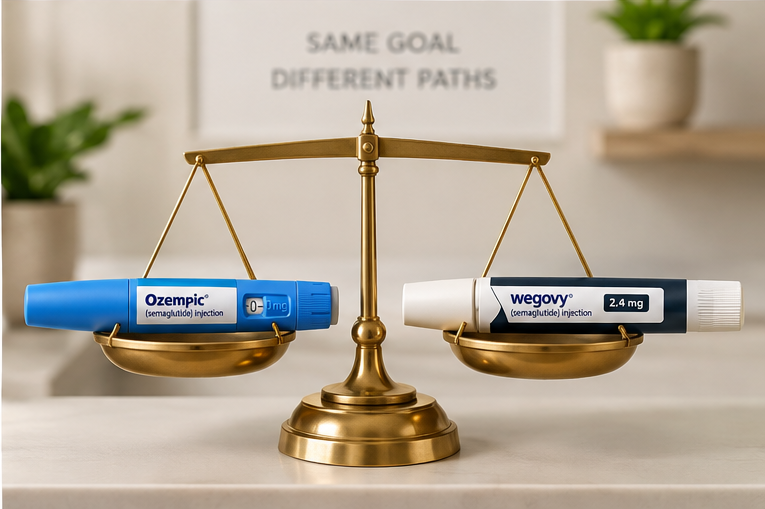
Ozempic® and Wegovy® contain the same active ingredient — semaglutide — and are made by the same manufacturer, Novo Nordisk. Yet they are approved for different purposes, dosed differently, and priced differently. If you are trying to understand which one your doctor might prescribe and why, the differences matter. Here is an evidence-based comparison, along with an honest look at where lifestyle change fits into the picture.
What Each Medication Is Approved For
Ozempic® is approved for adults with type 2 diabetes to improve blood sugar control. It also carries indications for reducing the risk of major cardiovascular events in adults with type 2 diabetes and established cardiovascular disease, and for slowing the progression of chronic kidney disease in certain patients with type 2 diabetes. Weight loss occurs with Ozempic, but it is not an FDA-approved indication — prescribing it for weight loss alone is off-label use. The full approved uses and warnings are detailed in the FDA prescribing information.
Wegovy® is approved for chronic weight management in adults with obesity (BMI 30 or higher) or overweight (BMI 27 or higher) with at least one weight-related condition, and in adolescents aged 12 and older who meet BMI criteria. In March 2024, the FDA added a second indication: reducing the risk of cardiovascular death, heart attack, and stroke in adults with established cardiovascular disease and obesity or overweight.
That second approval was significant. It made Wegovy the first weight-management medication formally recognized as reducing cardiovascular risk, based on outcomes rather than weight change alone.
How Much Weight Do People Actually Lose?
This is where a great deal of misinformation circulates, so the numbers deserve care.
In the STEP 1 trial — 1,961 adults with obesity or overweight, without diabetes — participants taking Wegovy 2.4 mg lost an average of 14.9% of their body weight over 68 weeks, compared with 2.4% on placebo. Novo Nordisk publishes the full trial results and study design for clinicians. For someone starting at 220 pounds, that is roughly 33 pounds over about 16 months.
The timeline matters as much as the number. Wegovy is titrated upward gradually over approximately 16 weeks to reduce gastrointestinal side effects, so patients have not yet reached the full maintenance dose at the three-month mark. Weight loss tends to be modest early, steepest in months four through nine, and typically plateaus somewhere between months 12 and 18. Real-world results generally run lower than trial averages — often in the 8–12% range — largely because of adherence and dose interruptions.
Ozempic produces less weight loss, because its maximum approved dose is lower. Ozempic is capped at 2 mg weekly; Wegovy’s standard maintenance dose is 2.4 mg. In diabetes trials, Ozempic at its higher doses produced average weight reductions in the range of 6 to 7 kilograms (roughly 13–15 pounds) over 40 weeks. Patients with type 2 diabetes typically lose somewhat less weight on semaglutide than patients without diabetes, a consistent finding across the pivotal trial program.
In March 2026, the FDA approved a higher-dose version, Wegovy HD (7.2 mg), which produced greater average weight loss than the 2.4 mg dose in trials. An oral semaglutide tablet formulation has also been approved for weight management. If you are researching this topic, be aware that dosing options have expanded considerably and older articles may be out of date.
What About Muscle? The Lean Mass Question
Any substantial weight loss — from medication, surgery, or diet — involves losing some lean tissue alongside fat. Semaglutide is no exception, and this deserves more attention than it usually receives.
A body composition substudy within STEP 1 used DEXA scanning to measure what participants actually lost. Total fat mass fell by 19.3%, and visceral fat — the metabolically active kind stored around the organs — fell by 27.4%. Total lean body mass also declined, by 9.7%. Across recent GLP-1 trials, lean tissue has accounted for roughly 26–40% of total weight lost.
There is an important nuance here. Because fat was lost in far greater proportion, participants’ lean mass as a share of total body weight actually increased by about 3 percentage points. Body composition improved overall. So the honest summary is neither “semaglutide destroys muscle” nor “semaglutide preserves muscle” — it is that fat loss substantially outpaces lean loss, while absolute lean mass still falls meaningfully.
Why this matters practically: lean mass drives resting metabolic rate, physical function, balance, and long-term weight maintenance. Losing a meaningful amount of it without a plan to counteract that loss makes weight regain more likely and function harder to maintain, particularly for older adults. Resistance training and adequate protein intake are the two interventions with the strongest evidence for protecting lean tissue during weight loss. Neither happens automatically with a prescription.
Cost: What Has Changed
Cost comparisons written before late 2025 are now substantially outdated.
List prices remain high — roughly $1,349 per month for Wegovy and around $999 for Ozempic — but very few self-paying patients now encounter those figures. Novo Nordisk has established direct-to-patient self-pay pricing through NovoCare® Pharmacy, and lowered its standard self-pay price in late 2025. As of mid-2026, standard self-pay pricing runs approximately $349 per month for Wegovy at doses up to 2.4 mg, with introductory pricing lower for new patients on starter doses, around $399 for Wegovy HD, and lower still for the oral tablets. Current figures by dose are published in the Wegovy price guide. Ozempic self-pay pricing is broadly comparable, running higher at the 2 mg dose.
Several caveats apply. These programs generally exclude patients with Medicare, Medicaid, TRICARE, or VA coverage. Patients with commercial insurance that covers the medication may do better with a manufacturer savings card than with the cash price. A separate Medicare pathway for eligible Part D members has been introduced. Terms change frequently, and the manufacturer reserves the right to modify these programs.
Insurance coverage for weight management remains inconsistent. Coverage is more often obtainable when the prescription is tied to an approved indication such as diabetes or cardiovascular risk reduction. Anyone weighing cost should verify current pricing directly rather than relying on published figures, including these.
Side Effects and Safety
The most common side effects of both medications are gastrointestinal: nausea, diarrhea, vomiting, constipation, and abdominal pain. These are usually most pronounced during dose escalation and often improve over several weeks. A minority of patients find them intolerable and discontinue.
Both carry a boxed warning regarding thyroid C-cell tumors, based on rodent studies. Human relevance has not been established, but both are contraindicated in people with a personal or family history of medullary thyroid carcinoma or Multiple Endocrine Neoplasia syndrome type 2.
Less common but serious risks include pancreatitis, gallbladder disease, kidney injury, and gastrointestinal complications such as ileus. The Ozempic label has been updated several times as these signals were evaluated — gallbladder disease in 2022, ileus and intestinal obstruction in 2023, and pulmonary aspiration risk during anesthesia in 2024. Patients scheduled for surgery or sedation should tell their anesthesiologist they are taking a GLP-1 medication.
Two areas have shifted recently and are worth stating precisely:
Suicidal ideation. Warnings about suicidal thoughts and behavior appeared on weight-management GLP-1 labels for years. In January 2026, following a meta-analysis of 91 controlled trials involving more than 107,000 patients and a cohort study of over 2.2 million patients using its Sentinel system, the FDA concluded that the evidence did not support an increased risk and requested removal of that warning from the labels of Wegovy, Saxenda, and Zepbound. European regulators reached a similar conclusion in 2024. The FDA still advises clinicians to discuss mental health with patients and to refer anyone reporting suicidal ideation for evaluation.
Vision. A rare eye condition called non-arteritic anterior ischemic optic neuropathy (NAION), which causes sudden and usually permanent vision loss in one eye, has been studied in connection with semaglutide since 2024. European regulators concluded it is a very rare side effect and added it to labeling there, and the UK’s MHRA issued a drug safety update in February 2026. As of this writing it is not on U.S. labels, and the FDA continues to evaluate. Patients experiencing sudden vision changes should seek immediate medical attention.
What the Long-Term Evidence Shows
Contrary to a common claim, multi-year data does exist. The SELECT trial followed 17,604 patients for a median of roughly 40 months and demonstrated a 20% reduction in major adverse cardiovascular events. STEP 5 followed patients for 104 weeks with sustained weight loss. These are substantial datasets.
What remains less certain is what happens over five, ten, or twenty years in a general population — and what happens after people stop.
On that second question, the evidence is fairly clear. In the STEP 1 trial extension, participants who had lost an average of 17.3% of body weight regained about 11.6 percentage points of it within a year of stopping, and most cardiometabolic improvements drifted back toward baseline. Obesity behaves as a chronic condition, and semaglutide appears to work while it is being taken.
Where Lifestyle Change Fits
None of this argues that these medications don’t work. They plainly do, and the cardiovascular outcome data has moved them beyond cosmetic weight loss into established preventive therapy.
But two specific gaps in the pharmacological approach point directly to where structured lifestyle intervention earns its place. The first is lean mass: a substantial share of the weight lost is lean tissue, and no prescription addresses that. Resistance training and sufficient protein do. The second is what happens after discontinuation, when weight tends to return unless eating patterns, activity levels, and the habits surrounding them have genuinely changed.
The Pritikin Program addresses both. Guests work with physicians, registered dietitians, and exercise physiologists on nutrition, structured exercise including resistance work, sleep, and stress management. For someone taking semaglutide, that combination protects the muscle the medication does not, and builds the habits that determine whether results hold afterward. For someone who has not started medication, it addresses the same underlying drivers directly.
The most productive framing is not medication versus lifestyle. It is that medication and lifestyle change address different parts of the same problem, and that the people who do best over the long run tend to have both.
The Bottom Line
Wegovy produces greater weight loss than Ozempic, primarily because it is dosed higher and specifically approved for that purpose. Ozempic is the appropriate choice for type 2 diabetes, where it also carries cardiovascular and kidney indications. Both share the same active ingredient and a similar side effect profile.
Whichever direction you are considering, the decision belongs with a physician who knows your history. And whatever you decide about medication, the questions of how to protect lean mass and how to sustain results afterward will still need answering.