
The Wall Sit Test: A Simple Measure of Lower-Body Strength After 60
After 60, lower-body strength isn’t just about fitness—it’s about independence. A simple test like the wall sit gives us a clear, honest look at how well your muscles can support everyday life, from getting out of a chair to climbing stairs with confidence.

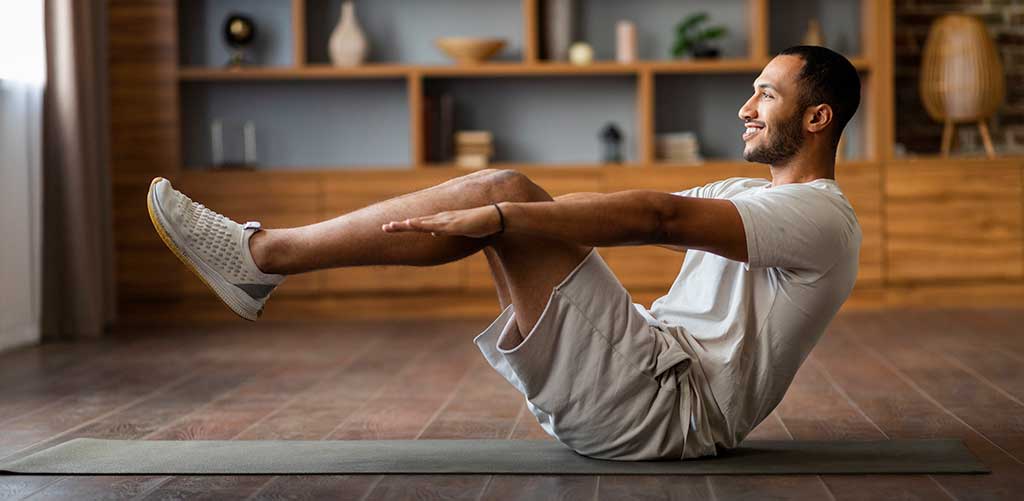
As we age, the strength in our legs quietly becomes one of the clearest signals of how well we’ll move, function, and stay independent in the years ahead. Few exercises reveal that strength as honestly as the wall sit. It requires no equipment, takes only a wall and a timer, and yet it offers a window into the muscular endurance that powers everyday movement. Below, we break down why the wall sit matters after 60, what your performance says about your functional capacity, and how to practice it safely.
Why the Wall Sit Reveals True Lower-Body Strength After 60
The wall sit is an isometric exercise, meaning the muscles generate and sustain force without any change in joint angle or muscle length. This makes it uniquely revealing of real functional capacity rather than momentary power.
The research backs this up. A study published in Aging Clinical and Experimental Research found that quadriceps strength is the sole predictor of how long older adults can sustain multi-joint functional tasks such as sit-to-stand repetitions. Notably, older adults tend to begin those tasks closer to their maximal voluntary contraction capacity than younger adults, leaving less reserve in the tank. A separate cross-sectional study in PLOS ONE reinforced this, identifying quadriceps strength as the strongest correlate of independence in activities of daily living among older adults.
This matters even more as we age because lower-limb strength declines by roughly 10 to 15 percent per decade after age 40, with that decline accelerating after 60. A timed isometric hold like the wall sit becomes a sensitive, practical way to screen for those losses before they affect daily life.
What Counts as a “Top-Tier” Wall Sit Time Over 60
It’s worth being transparent: formal normative data for the wall sit specifically in older adults is limited. The most commonly referenced standards come from trainer guidelines and age-adjusted charts, which consistently show performance declining with age. For adults over 60, average performance tends to fall around 20 to 40 seconds.
That said, multiple studies confirm the wall sit has high test-retest reliability and strong associations with functional outcomes and fall risk. With proper form, a strong benchmark looks like this:
- Knees bent at roughly 90 degrees
- Back flat against the wall
- No arm support
- A hold of 60 to 90 seconds
Holding past 60 seconds is a meaningful signal of quadriceps endurance and functional reserve.
How Wall Sit Performance Translates to Everyday Movement
The connection between wall sit performance and daily life is direct. Research in Aging Clinical and Experimental Research confirms that strengthening the quadriceps improves an older adult’s ability to perform multi-joint tasks repeatedly throughout the day. Rising from a chair, climbing stairs, and walking for sustained periods all draw on the same muscle groups the wall sit targets.
The neuromuscular evidence is compelling, too. A 2026 study published in the International Journal of Environmental Research and Public Health found that isometric lower-limb training in older adults produced significant improvements in strength, balance, mobility, and functional outcomes. Participants made meaningful gains on the clinical 6-Minute Walk Test and the 5 Times Sit-to-Stand test, both of which directly reflect real-world movement capacity. In practical terms, someone who can hold a wall sit for 60 seconds or more has shown the muscular endurance to meet daily physical demands without fatiguing quickly.
“After 60, lower-body strength isn’t just about fitness—it’s about independence. A simple test like the wall sit gives us a clear, honest look at how well your muscles can support everyday life, from getting out of a chair to climbing stairs with confidence.”
— Jaqueline Gavino, Director of Fitness, Pritikin Longevity Center
How Often to Practice Wall Sits for Safe, Steady Gains
Improvement doesn’t require a punishing schedule. A community-based study published in BMC Geriatrics, which followed older adults with a mean age of 80, found that once-weekly supervised strength and balance training over two or more years produced significant improvements in isometric knee extension strength, chair-rise performance, and walking speed. Even modest frequency yields measurable results.
For most people getting started, the following approach works well:
- Aim for 2 to 3 sessions per week
- Begin with shorter holds of 20 to 30 seconds
- Progress hold time gradually rather than forcing maximum effort
This principle of progressive overload, slowly increasing hold time, is the key to building endurance safely. A feasibility trial of isometric wall squats published in the Journal of Cardiopulmonary Rehabilitation and Prevention found no serious side effects, along with high participant satisfaction and a strong intention to continue, supporting the wall sit’s safety as a regular practice.
Are Wall Sits Safe Over 60, and How to Modify Them
For most older adults, the answer is yes. The wall sit is a closed-chain, low-impact isometric exercise that places minimal shear force on the knee joint compared with dynamic movements like lunges or squats.
There’s a notable cardiovascular benefit, too. A 2023 meta-analysis published in the British Journal of Sports Medicine, which analyzed 270 randomized controlled trials with nearly 16,000 participants, found that isometric exercise produced the greatest reductions in resting blood pressure of any exercise type tested, including aerobic training, HIIT, and dynamic resistance training. The wall sit ranked as the single most effective individual exercise for reducing systolic blood pressure.
Still, anyone with severe knee osteoarthritis, a recent joint replacement, or uncontrolled hypertension should consult a physician before beginning.
Modifications to Make Wall Sits More Accessible
- Reduce the knee angle. Starting at 110 to 120 degrees instead of 90 significantly reduces joint compression while still activating the target muscles, especially if you’re using a leg extension machine at the gym.
- Keep a chair nearby. Having one within reach adds confidence and safety during the early stages.
- Shorten the hold. Even 10 to 15 second holds repeated several times build endurance progressively.
- Add lumbar support. Place a cushion or rolled towel behind your lower back, or focus on drawing your belly button toward your spine. This creates a dual effect, engaging both the legs and the lower-back muscles.
These adjustments open the wall sit up to a much broader range of older adults while preserving its core benefit as a strength and endurance stimulus.
Build Lasting Strength With Pritikin
Knowing your numbers is one thing; building the strength behind them is another. That’s where structured, expert guidance makes the difference. Pritikin is the only resort-based program offering scientifically proven results documented in more than 100 peer-reviewed medical journals. For nearly 50 years, it has been a leader in sustainable weight loss and the healing of lifestyle diseases.
Guests come to this immersive health retreat to lose weight, improve diabetes, lower cholesterol, and reduce the risk of coronary heart disease, all under the care of a physician-led team of wellness professionals. The Pritikin Program pairs proven nutrition with a comprehensive exercise program and fitness camp designed to help you move better and live stronger, exactly the kind of functional capacity a strong wall sit reflects.
If you’re curious about why Pritikin works or the results guests achieve, you can explore how the program comes together and see whether it’s the right fit for your goals.
Talk to a Pritikin Representative
Taking the next step is simple. To learn how Pritikin can help you build lower-body strength, lower your blood pressure, and reclaim your independence, book a consultation with a Pritikin representative today. A short conversation can set you on the path to a stronger, healthier life.