
Think You Need Eight Glasses of Water a Day? Not Exactly.
Hydration is not a glass-counting exercise. It is the sum of what you drink and what you eat, calibrated to your body size, your activity, your climate, your age, and your medical history. For many adults, eight glasses of water understates the requirement. For others, it overstates it. For nearly everyone, it is the wrong question.

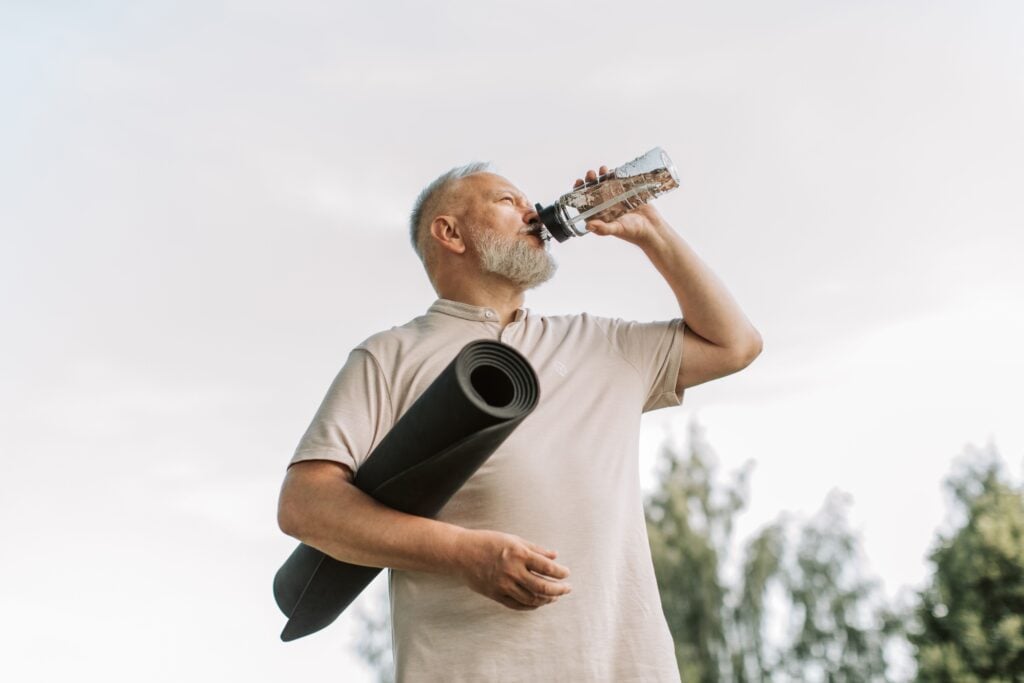
The Most Repeated Hydration Rule in Health
Few pieces of health advice are repeated as confidently as the instruction to drink eight glasses of water a day. It shows up on the side of tumblers, inside fitness apps, in office break rooms, and in casual conversation between friends who are otherwise skeptical of nutrition claims. The number is tidy. It is easy to remember, easy to repeat, and easy to feel guilty about missing.
It is also not what the science says. Current expert guidance does not set a universal glass count. It focuses instead on total daily water intake, the water in every beverage you drink plus the water hidden inside the foods you eat. Once you understand that distinction, the entire conversation around daily hydration changes. You stop chasing a number that was never designed for you and start paying attention to the signals your own body is already sending.
That shift is genuinely good news. Most people who worry that they are failing the eight glasses of water standard are closer to being well hydrated than they realize, because the salad, the soup, the berries, and the morning coffee all counted the whole time. Others discover that their real fluid needs are considerably higher than eight glasses of water — and that the generic rule was quietly underselling them.
At Pritikin Longevity Center, a physician-led health and wellness retreat in Doral, Florida, guests learn to replace rigid rules with individualized, evidence-based practice. Hydration is one of the clearest examples of how that approach works, and one of the easiest to bring home.
Where the Eight Glasses of Water Rule Actually Came From
The origin story is more mundane than the myth. A widely cited 2002 review in the American Journal of Physiology by physiologist Heinz Valtin traced the advice back to a 1945 recommendation from the Food and Nutrition Board, which suggested roughly one milliliter of water per calorie consumed – about 2.5 liters a day on a 2,000-calorie diet. That works out to roughly eight glasses of water.
The recommendation, however, contained a second sentence that almost never traveled with the first: most of that quantity is already contained in prepared foods. The qualifier was dropped. The number survived. Nearly eighty years later, a partial quotation has become one of the most durable rules in popular health.
Valtin’s review found no supporting scientific evidence for the eight glasses of water prescription as it is commonly understood. That does not mean hydration is unimportant — quite the opposite. It means the popular shorthand was never a serious clinical target.
Food Counts Toward Your Daily Hydration
About 20% of daily hydration comes from food, particularly whole plant-based foods. Fruits, vegetables, soups, cooked whole grains, beans, and yogurt all deliver meaningful water alongside their nutrients. For most adults, roughly 80% of daily fluids come from beverages and 20% from food.
Consider how water-dense common produce actually is:
- Cucumber: about 96% water by weight
- Lettuce and celery: about 95% water
- Tomatoes: about 94% water
- Watermelon and strawberries: about 91–92% water
- Broth-based soups, oatmeal, and cooked grains: substantial water absorbed during cooking
This is why an eating pattern built on vegetables, fruits, whole grains, and legumes supports daily hydration almost automatically. A person eating that way is drinking with every bite. Someone living on dry, processed, calorie-dense foods has to make up the entire difference at the tap — and often does not.
The practical takeaway reframes hydration as a nutrition question rather than a beverage question. When you improve the quality of your plate, you improve your fluid status, your fiber intake, your micronutrient intake, and your satiety at the same time. The Pritikin Eating Plan is deliberately structured around exactly these foods, which is why guests frequently report feeling better hydrated within days of arriving without consciously drinking more.
So How Much Fluid Do You Actually Need?
The National Academies of Sciences, Engineering, and Medicine set adequate intake values for total water — beverages plus food combined. Those values are approximately 3.7 liters per day for men and 2.7 liters per day for women, which translate to roughly 16 eight-ounce glasses for men and just over 11 for women.
Subtract the share that arrives through food, and the beverage-only guidance lands at approximately:
- Men: about 12.5 eight-ounce glasses per day
- Women: about 9 eight-ounce glasses per day
Notice what this does to the familiar rule. For most adults, eight glasses of water is not the target — it is below it. The number people have been anxiously trying to reach was, for many, never ambitious enough. And for others, it is far too much. Individual requirements shift with exercise, heat, illness, pregnancy, breastfeeding, altitude, medications, and medical conditions affecting the heart and kidneys.
There Is No One-Size-Fits-All Hydration Recommendation
Hydration needs should be individualized rather than standardized. Lawrence E. Armstrong, one of the field’s leading hydration researchers, has published extensively demonstrating that fluid needs vary substantially with body size, sweat rate, exercise intensity, ambient temperature, humidity, age, and medical conditions. His work emphasizes that no single fluid prescription fits everyone. (Armstrong LE. Challenges of linking chronic dehydration and fluid consumption to health outcomes. Nutr Rev. 2012.)
A 130-pound woman working at a desk in an air-conditioned office and a 220-pound man cycling outdoors in a Florida summer do not share a fluid requirement. Treating them as though they do is not simplification — it is inaccuracy dressed as convenience.
At Pritikin, the clinical team uses a practical starting guideline of roughly half your body weight (or ideal body weight, for some individuals) in ounces of fluid per day, then adjusts based on exercise, climate, urine color, medications, and medical conditions. A 160-pound person would begin near 80 ounces — about ten glasses — and refine from there. It is a starting line, not a finish line, and that distinction matters enormously.
As We Age, Thirst Becomes a Less Reliable Signal
Thirst is a reasonable guide in early adulthood. It becomes less trustworthy with age, because the sensitivity of the body’s thirst mechanism naturally declines. Older adults can be meaningfully dehydrated before feeling any urge to drink, which is one reason dehydration is a common contributor to hospital admissions later in life.
Rather than waiting for thirst, watch for objective markers:
- Urine color: pale yellow rather than dark yellow
- Urination frequency: regular output through the day, typically every three to four hours
- Physical signals: dry mouth, unexplained fatigue, headache, dizziness, or difficulty concentrating
Cognitive effects deserve particular attention. Research indicates that even a 1–2% drop in hydration status can affect concentration, short-term memory, and alertness. Many people who assume they need more caffeine actually need more water. This connection between fluid status and clear thinking is one of several reasons hydration turns up so consistently among the daily habits of people who feel younger than their age.
How Do You Know If You Are Well Hydrated?
The simplest assessment requires no counting at all. Check the color of your urine. Pale yellow generally indicates adequate hydration; consistently dark yellow suggests you need more fluid. Combine that with a straightforward question — are you frequently thirsty? — and you have a more accurate picture of your status than any glass tally could provide.
This is the heart of the matter. Counting eight glasses of water measures your compliance with a rule. Checking urine color and thirst measures your actual physiology. One is a proxy. The other is the thing itself. Understanding the full role of hydration in total body health — from circulation and blood pressure to digestion, joint lubrication, and temperature regulation — makes it much easier to prioritize the signal over the score.
Can You Drink Too Much Water?
Yes, though it is uncommon. Consuming water far faster than the kidneys can excrete it dilutes blood sodium, a condition called hyponatremia. It occurs most often in endurance athletes who drink aggressively during prolonged events, and it can be serious.
The Pritikin guidance is measured: drink deliberately during and after physical activity, and drink to thirst at other times of day. An eating pattern rich in whole plant foods supplies both a large share of daily fluid needs and adequate sodium for most active people, which reduces the risk on both ends.
What Should You Be Drinking?
Plain water remains the foundation. It is calorie-free, inexpensive, and universally available. A few practical distinctions are worth knowing:
- Tap versus bottled: Municipal tap water in the United States is almost always safe. Testing by independent organizations has found that water from a bottle is not reliably cleaner or safer than tap, and a substantial share of it is tap water to begin with. If taste or local water quality is a concern, a filter meeting NSF/ANSI Standard 53 is a sound solution — one of many practical bottled water facts worth weighing before you buy another case.
- Coffee and tea: Contrary to long-standing belief, moderate consumption of caffeinated beverages contributes to daily hydration and does not produce a net fluid deficit in habitual drinkers.
- Sports drinks and coconut water: Pure, unflavored coconut water contains about 45 calories per eight-ounce cup. It can serve as fluid and electrolyte replacement during intense sessions lasting more than an hour, but for anyone pursuing weight loss, liquid calories can quietly cancel out the workout that earned them.
- Sugar-sweetened beverages and alcohol: Both work against the goal. Alcohol in particular promotes fluid loss.
What you drink matters as much as how much. Beverages that arrive without calories, added sugar, or alcohol let you meet your daily hydration needs without simultaneously working against your weight, blood sugar, or blood pressure. Plain water — filtered if you prefer the taste — handles the overwhelming majority of the job for the overwhelming majority of people. Everything else on this list is situational: useful in the right context, counterproductive in the wrong one. When you are unsure, reach for the option that costs you nothing.
Hydration Around Exercise
Fluid strategy tightens when you train. Because an eating plan rich in fruits and vegetables is already water-dense, pre-workout loading is generally unnecessary. Pritikin’s exercise physiologists recommend approximately 8 to 10 ounces of water every 20 minutes during activity, and about 8 ounces after exercise for every half-pound of body weight lost during the session.
Adequate hydration during training helps prevent fatigue, protects cardiovascular function and blood pressure regulation, and preserves the body’s ability to cool itself through sweating. Guests work through this in practice as part of the supervised exercise program, where trainers pair effort with individualized fluid guidance rather than a generic eight glasses of water benchmark.
Building Daily Hydration Habits That Last
Knowledge changes behavior only when it becomes routine. A handful of low-effort strategies consistently work:
- Start the morning with a glass of water before coffee or tea
- Keep a reusable bottle within arm’s reach at your desk and in the car
- Pair fluid intake with existing anchors — every meal, every meeting, every hour
- Build water-rich produce into every meal rather than treating it as a side
- Flavor water naturally with citrus, cucumber, mint, or berries if plain water bores you
- Check urine color once daily rather than tallying glasses
- Increase intake proactively in heat, at altitude, during illness, and on training days
These are small, repeatable actions, which is precisely why they endure. The same principle governs healthy eating habits that last a lifetime: sustainable change comes from systems that fit your actual life, not from rules that demand daily willpower.
How Pritikin Turns Hydration Into Lasting Practice
Hydration is not treated as a standalone tip at Pritikin. It is woven through the Pritikin Program, where nutrition education, medical oversight, cooking instruction, exercise physiology, and behavioral coaching operate as a single system. Guests learn why fluid status affects blood pressure, blood sugar, digestion, cognition, and exercise capacity — and then practice the habits in real meals, real workouts, and real daily routines for the length of their stay.
Physicians monitor fluid status directly for guests managing heart disease, diabetes, or kidney concerns, where hydration decisions carry real clinical weight and generic advice can be actively unhelpful. Registered dietitians translate the science into individualized targets. Chefs and instructors demonstrate how water-rich, high-volume meals satisfy appetite on fewer calories, which is one of the quiet mechanisms behind sustainable weight loss.
For over 50 years, Pritikin has been a pioneer in scientifically proven lifestyle medicine. Its results are documented in more than 100 peer-reviewed medical journals, spanning improvements in weight, cholesterol, blood pressure, and blood sugar control. Hydration is one thread in that evidence-based fabric — a small habit that supports nearly every other outcome guests come to achieve.
Speak With a Pritikin Program Advisor
Guests who want a fluid plan built around their body, their medications, and their goals — rather than a number printed on a water bottle — can start with a conversation. A Pritikin representative can walk you through the program, the medical team, accommodations, and availability, and help you determine whether an immersive stay fits your health objectives. Schedule a consultation to begin planning your retreat.
The Bottom Line on Daily Hydration
Hydration is not a glass-counting exercise. It is the sum of what you drink and what you eat, calibrated to your body size, your activity, your climate, your age, and your medical history. For many adults, eight glasses of water understates the requirement. For others, it overstates it. For nearly everyone, it is the wrong question.
The better questions are simpler and more useful. Is your urine pale yellow? Are you drinking regularly through the day rather than in a panicked evening catch-up? Is your plate full of the fruits and vegetables that deliver water, fiber, vitamins, and minerals in the same bite? Do you drink more when you sweat more?
Answer those honestly and you will meet your daily hydration needs without ever counting to eight — and you will gain, along the way, an eating pattern that supports your heart, your weight, your energy, and your years.